Home / Guides / Which Teeth Usually Rot First? The Answer Changes With Age
For Patients
Which Teeth Usually Rot First? The Answer Changes With Age
By Ross Seymour of Free Dentist Office, a directory of dentists who take Medi-Cal, built from the state's public provider data. It is not run by any state agency.
For most people, the back teeth rot first. The CDC says about 90 percent of tooth decay in permanent teeth starts in the chewing surfaces of the back teeth, the molars and premolars. Babies are the exception. Their decay usually starts in the four upper front teeth. In older adults, the roots are the new weak spot.
- Most people. The molars and premolars, on the bumpy chewing surface
- Babies and toddlers. The four upper front teeth
- Children from about 6. The first permanent molars, which CDC says can come in between ages 6 and 7
- Adults. The chewing surfaces and the spots between teeth where food gets stuck
- Older adults. Tooth roots that show where the gums have pulled back
- Kids on Medi-Cal. Sealants and fluoride are covered
Back Teeth Go First
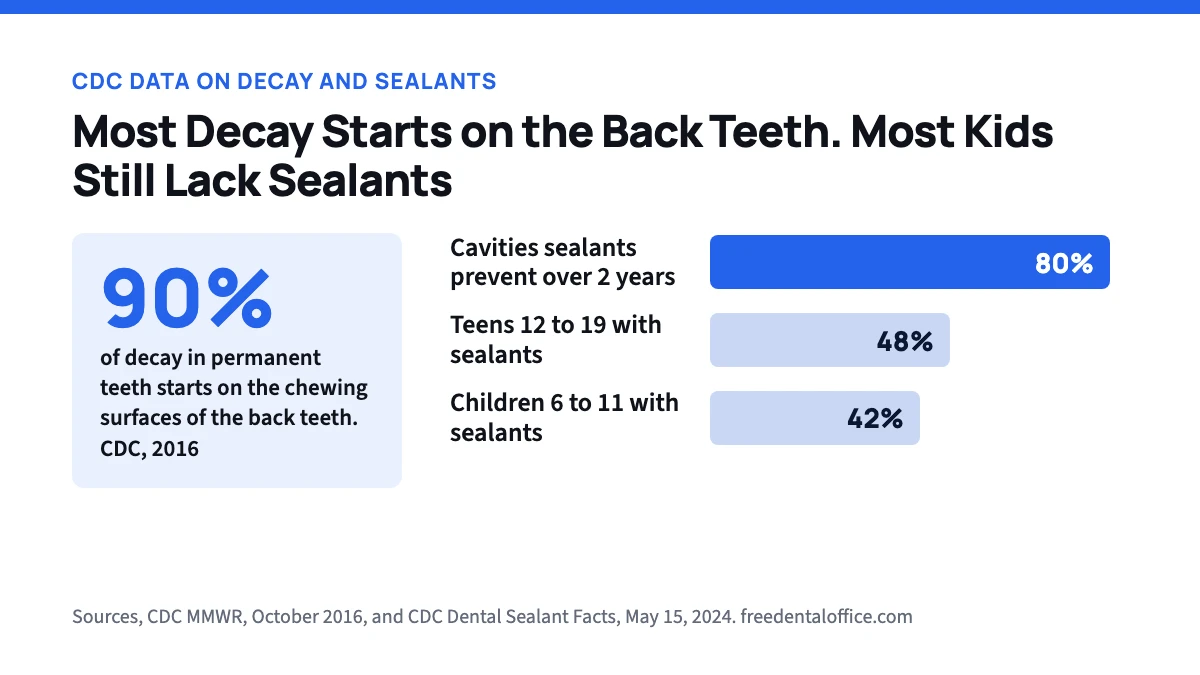
Ask a dentist which teeth rot first and the answer is almost always the same. The molars and premolars at the back. A CDC report on school children, published in 2016, says about 90 percent of tooth decay in permanent teeth happens in the chewing surfaces of the back teeth.
Run your tongue over a back tooth and you will feel why. The top is not flat. It is full of pits and grooves, and food packs into them every time you chew. A toothbrush can sweep over a groove without ever reaching the bottom of it. The back of the mouth is also the hardest place to reach with a brush, so those teeth get the least cleaning and the most food.
The American Dental Association's patient site, MouthHealthy, says cavities often form on the tops of the teeth where you bite and in between the teeth where food gets stuck. Those two spots cover most of what a dentist finds.
Babies Are the Exception. Front Teeth Go First
In babies and toddlers the pattern flips. The National Institute of Dental and Craniofacial Research, part of NIH, says severe early childhood decay starts in the baby's front teeth and then spreads to the back teeth. Victoria's state health service in Australia puts it more plainly. The upper four front baby teeth are the ones most often hit.
The usual cause is a bottle or a sippy cup that stays in the mouth for a long time, most of all at bedtime. Milk or juice sits on the upper front teeth while the child sleeps, and there is less saliva at night to wash it away.
The first sign is easy to miss. Victoria's health service describes it as a dull white band on the tooth, right next to the gum line. If you see that on your child's front teeth, show it to a dentist. Baby teeth matter. They hold space for the adult teeth and help a child eat and talk.
The Six Year Molars Are the Ones to Watch in Kids
Around age 6 the first permanent molars come in. A 2016 CDC report says they can erupt between ages 6 and 7. They do not replace a baby tooth. They come in behind the last baby teeth, so many parents do not notice them and treat them like baby teeth that will fall out. They will not. They have to last a lifetime.
These are the teeth sealants were made for. A sealant is a thin coating a dentist or hygienist paints into the grooves of a back tooth. CDC's sealant facts page, dated May 15, 2024, says sealants prevent 80 percent of cavities in the back teeth over 2 years. The same page says children aged 6 to 11 without sealants have almost 3 times as many cavities in their first molars.
Most children still go without them. That CDC page says only 42 percent of children aged 6 to 11 have sealants on their permanent teeth, and 48 percent of teens aged 12 to 19. If your child is on Medi-Cal, Smile California lists molar sealants and fluoride varnish among the covered services for kids aged 4 to 12, checked in October 2026.
In Adults, Look Between the Teeth
Adults keep the same weak spot on the chewing surfaces. They add a second one. The tight spaces between teeth, where floss goes and a brush does not. Decay there can grow out of sight, and a dentist often finds it on an x ray before you can see or feel anything.
It is common. The CDC page on cavities, last updated May 15, 2024, says 1 in 5 adults aged 20 to 64 has at least one untreated cavity right now. Most of them do not know it, because early decay does not hurt.
Things that raise the risk for adults are simple. Sipping sugary drinks or snacking all day. Not using fluoride toothpaste. Medicines that dry the mouth. MouthHealthy lists dry mouth from medicine as a risk on its own, because saliva is what rinses and repairs the teeth between meals.
In Older Adults, the Roots Become the Target
Gums tend to pull back with age. NIDCR says many older adults have receding gums, which lets decay causing bacteria reach the root of the tooth. Roots are not covered by hard enamel the way the crown of the tooth is, so decay can start there and spread along the gum line.
The numbers are large. The CDC says nearly all adults aged 65 and older, 96 percent, have had a cavity, and 1 in 6 has a cavity that is not treated. The CDC also lists people who can see their tooth roots and people who take medicine that weakens how saliva protects the teeth as being at higher risk.
Old fillings and crowns also need watching as people age. If you notice a dark line where a tooth meets the gum, or a filling edge that catches floss, mention it at your next visit.
What Early Rot Looks Like
Decay does not start as a hole. NIDCR says that in early tooth decay there are usually no symptoms at all. The first thing you might see is a white spot where minerals have left the enamel. MouthHealthy says a cavity at this stage can look like a white spot and can be healed.
Later it can turn brown or black. The CDC says cavities cause pain and sensitivity as they get bigger, most of all when they get close to the nerve in the middle of the tooth. By the time a tooth hurts, the decay has usually been there a while.
What Rot Looks Like, Stage by Stage
- A white spot
- Minerals are leaving the enamel. No hole yet. This stage can still heal
- A brown or black spot
- Decay has gone further and likely needs a dentist to repair it
- Sensitive to cold or sweet
- The cavity may be getting bigger
- Pain that lingers
- The decay may be close to the nerve. Book a visit soon
- Swelling in the face or a fever
- Treat it as urgent
Can Rot Be Stopped Once It Starts?
Sometimes. NIDCR says tooth decay can be stopped or even reversed at the white spot stage, before a hole forms. Enamel can repair itself with minerals from saliva and fluoride from toothpaste, and a dentist or hygienist can apply stronger fluoride to help.
Once there is a real hole, it does not grow back. A dentist has to clean out the decay and fill it. Only a dentist who has looked at the tooth can tell you which stage you are at, so treat this page as a guide to what to ask, not a diagnosis.
If you only remember one thing, make it this. The back teeth and the gaps between teeth are where to aim the brush and the floss, every day, with fluoride toothpaste.
If Cost Is What Is Holding You Back
A small cavity caught early is the cheapest dental problem you will ever have. A tooth that is left until it hurts can need a root canal or an extraction instead.
If you are in California and have Medi-Cal, Smile California lists exams, x rays, cleanings and fillings as free or low cost dental services, checked in October 2026. Starting July 1, 2027, it says some adults will lose full dental benefits based on immigration status, while emergency care stays covered. If you have no coverage, community health centers charge by income. Use the search on this site to find an office near you that takes your coverage, and call before you go to confirm.
Before You Spend a Dime
Which teeth are most likely to rot?
The back molars and premolars, on their chewing surfaces. The CDC says about 90 percent of decay in permanent teeth starts there. In babies, the upper front teeth are hit most often.
How fast do teeth start decaying?
There is no set clock. Speed depends on how often you have sugar, whether you use fluoride and how much saliva you make. Early decay usually has no symptoms, which is why regular check ups catch it before you feel it.
Can you stop teeth rotting once they start?
At the white spot stage, before a hole forms, NIDCR says decay can be stopped or reversed with fluoride. Once there is a hole, a dentist needs to repair it.
What do teeth look like when they first start rotting?
A chalky white spot or band, often near the gum line or in the grooves of a back tooth. Later the spot can turn brown or black.
Why do baby teeth rot in the front first?
Milk or juice from a bottle or sippy cup pools on the upper front teeth, most of all at night when there is less saliva. NIDCR says severe early childhood decay starts in the front teeth.
Are sealants covered for kids on Medi-Cal?
Yes. Smile California lists molar sealants and fluoride varnish for kids on Medi-Cal, checked in October 2026. Ask the office to check your child's back teeth for them.
Sourced From
- NIDCR (NIH), Tooth Decay
- CDC, About Cavities (Tooth Decay)
- CDC, Dental Sealant Facts
- CDC, MMWR Vital Signs, Dental Sealant Use and Untreated Tooth Decay Among U.S. School-Aged Children (2016)
- American Dental Association, MouthHealthy, Understanding and Preventing Cavities
- Better Health Channel (Victoria State Government), Tooth Decay in Young Children
- Smile California, Covered Services for Kids (4 to 12)
- Smile California, Covered Services for Adults (21 to 54)
- Smile California, 2027 Medi-Cal Dental Benefit Changes
Next Problem to Solve
- Dental Care for Your Kids on Medi-CalWhat children get under Medi-Cal dental, when the first visit should happen, and how braces are decided.
- What Denti-Cal Pays For. A Plain ListWhat Medi-Cal dental covers for adults and children, what it does not, and how to check before you agree to treatment.
- Your Tooth Hurts and You Have No Money. What NowWhere to go when a tooth is hurting and you cannot pay, including what an emergency room can and cannot do for a dental problem.