Home / Guides / Frequent Sugar and Gum Disease Destroy the Most Teeth
For Patients
Frequent Sugar and Gum Disease Destroy the Most Teeth
By Ross Seymour of Free Dentist Office, a directory of dentists who take Medi-Cal, built from the state's public provider data. It is not run by any state agency.
Sugar that hits your teeth again and again, all day long, destroys more teeth than anything else. Every sip or snack feeds the germs that make acid, and the Oral Health Foundation says that acid can keep working for up to 30 minutes each time. Gum disease is the other big one. The CDC names cavities and gum disease as the two leading causes of tooth loss, and gum disease often doesn't hurt until a tooth is already loose.
- The top cause of decay. Sugar or starch many times a day, most of all in drinks you sip
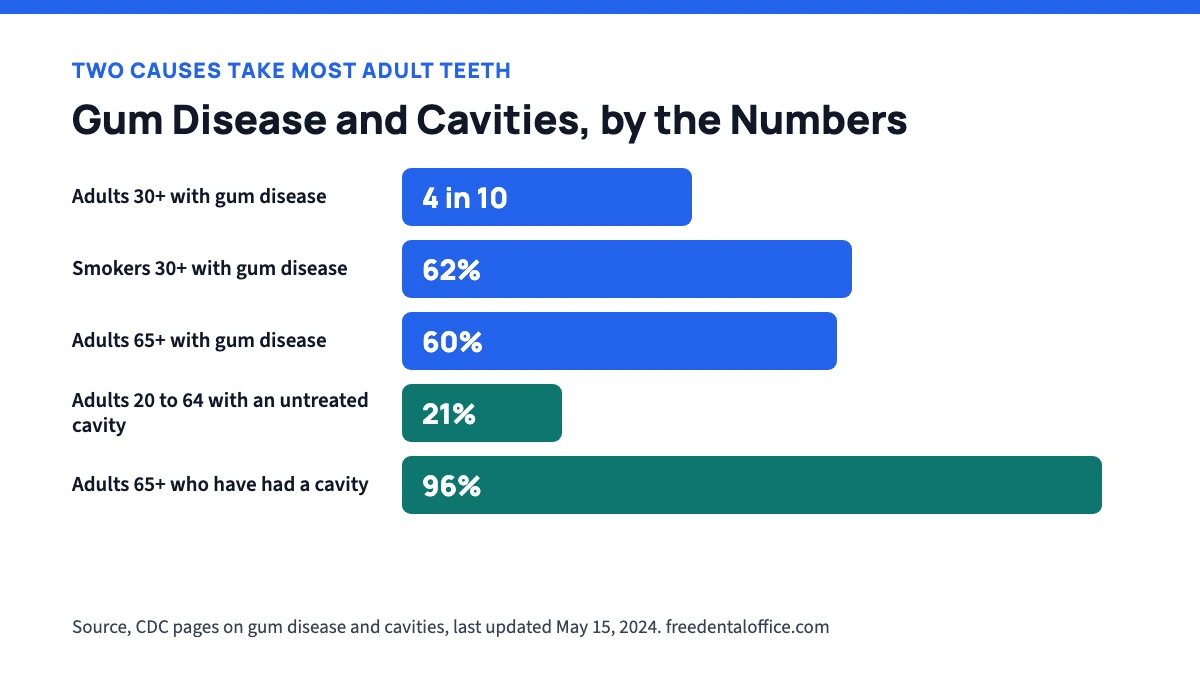
- The quiet tooth taker. Gum disease. CDC says about 4 in 10 adults 30 and older have it
- Makes both worse. Smoking. CDC says smokers have twice the risk of gum disease
- Takes away your defense. A dry mouth from medicines, alcohol or caffeine
- Breaks what decay misses. Grinding, chewing ice and opening things with your teeth
- On Medi-Cal. Deep cleaning, fluoride and fillings are covered for adults
It's How Often, Not How Much
What destroys teeth the most is one of the home care questions people ask Google most. Most lists online answer it with a row of foods, from candy to citrus to chips. The real answer is less about which food and more about how often it touches your teeth.
The CDC explains the cycle in plain terms. Germs stick to your teeth, and you feed them every time you eat or drink. They turn sugar into acid, and the acid dissolves the hard outer layer of the tooth. Saliva then clears the acid and helps repair the enamel. A cavity starts when the repair can't keep up.
That is why timing matters so much. The Oral Health Foundation, a UK dental charity, says the acid can keep working for up to 30 minutes after you eat sugar. It also says that frequent snacking or sipping can put your teeth under constant attack. Eat a cookie with lunch and your teeth get one attack and time to recover. Sip a sweet drink from 9 to noon and the clock keeps resetting.
So a soda finished with a meal is less harmful than the same soda nursed for three hours. Both have the same sugar. Only one keeps your mouth acid the whole morning. If you change one thing after reading this, keep sugar to mealtimes and drink water in between.
Drinks Do More Damage Than Food
Drinks are the worst offenders because people sip them slowly and they wash over every tooth. The University of Rochester Medical Center says carbonated soft drinks are the leading source of added sugar among kids and teens. The ADA's patient site, MouthHealthy, says plaque germs use that sugar to make acid that attacks the enamel.
Sugar free doesn't make a drink safe. MouthHealthy says most carbonated soft drinks, including diet soda, are acidic and bad for your teeth. The Oral Health Foundation says even sugar free fizzy drinks can do harm because of their high acid. Acid wears enamel away on its own, with no germs needed.
Sports and energy drinks belong on the same list. MouthHealthy says sugar is a top ingredient in many of them, and it points to the American Academy of Pediatrics, which says they are usually not needed outside long, hard exercise. Sweetened coffee and tea count too. MouthHealthy says caffeine can also dry out your mouth.
A few habits cut the harm. Drink acidic drinks with a meal, not across the afternoon. Use a straw, which the Oral Health Foundation says can reduce contact with your teeth. Drink water after. And wait at least 30 minutes before you brush after something acidic, as the same charity advises, so you don't scrub softened enamel.
Gum Disease Takes Teeth Without Hurting
Cavities get the attention because they hurt. Gum disease does its damage quietly. The CDC says gum disease and cavities are the two leading causes of tooth loss. The CDC describes gum disease as inflammation and infection of the gums and the bone that hold your teeth in place. It can grow for years with little pain.
It is very common. The CDC says about 4 in 10 adults aged 30 and older have some level of gum disease, based on 2009 to 2014 data. That is about half of men and a third of women. Among adults 65 and older, it is about 60 percent.
The signs are easy to wave off. The CDC lists red, swollen or tender gums, bleeding gums and gums that have moved away from the teeth. Later come loose or sensitive teeth, painful chewing and a change in how your teeth fit together when you bite. Bleeding gums are worth a visit, even if they don't hurt.
The good news is that fewer people lose all their teeth than before. The National Institute of Dental and Craniofacial Research says about 15 percent of adults 65 and older had no natural teeth left in its 2017 to March 2020 data, down from 27 percent in 1999 to 2004. For adults 20 to 64, the share was about 2 percent.
Ranked by the Damage It Does
- 1. Sipping soda, juice or sweet coffee for hours
- Keeps fresh acid on your teeth all day. The main cause of cavities
- 2. Gum disease left alone
- Breaks down the bone and tissue that hold teeth. Teeth loosen and can come out
- 3. Smoking or chewing tobacco
- Twice the risk of gum disease, and treatment works less well
- 4. A dry mouth
- Less saliva to wash away acid and put minerals back in enamel
- 5. Acid drinks, even sugar free ones
- Wear the enamel down over time
- 6. Grinding and clenching
- Cracked, chipped, loose and worn down teeth
- 7. Chewing ice or hard candy
- Chips and breaks that can turn into an emergency
- 8. Skipping checkups
- Small problems grow into big ones
Smoking Raises the Odds on Everything
If you smoke, gum disease moves to the top of your list. The CDC says smokers have twice the risk of gum disease compared with nonsmokers. The risk climbs with the number of cigarettes and the number of years. Its gum disease page says about 62 percent of current smokers aged 30 and older have it.
Smoking also makes treatment work less well, the CDC says, so the same deep cleaning does less for a smoker than a nonsmoker. In severe cases, the CDC says, gum disease can make your teeth fall out.
Chewing tobacco is no safer for your mouth. Smile California, the state's Medi-Cal Dental site, tells adults not to smoke or chew tobacco, which stains teeth, causes bad breath and can cause cancer. If you are trying to quit, tell your dentist. They can watch your gums more closely while you do.
A Dry Mouth Leaves Your Teeth Unguarded
Saliva is your teeth's repair crew. The NIDCR says saliva holds minerals such as calcium and phosphate that help keep teeth strong and fight decay. When your mouth makes less of it, acid stays longer and the repair work slows down.
Medicines are the usual cause. The NIDCR says hundreds of medicines can make the glands put out less saliva, including common ones for high blood pressure, depression and bladder control. MouthHealthy adds that alcohol dries the mouth, and that heavy drinking over time can cut saliva and raise the risk of decay and gum disease.
Don't stop a medicine on your own because of your teeth. Tell your dentist and your doctor what you take. The NIDCR suggests drinking plenty of water, chewing sugarless gum or sucking sugarless hard candy to get saliva flowing, and limiting caffeine, alcohol and tobacco. Skip the sweet drinks you might reach for to wet your mouth. A dentist or doctor can look for the cause and may suggest a change in medicine or a saliva substitute.
Grinding, Ice and Teeth Used as Tools
Some damage has nothing to do with germs. It is force. Cleveland Clinic says grinding your teeth can lead to worn down enamel and loose or cracked teeth, along with jaw pain. It often happens during sleep, so many people don't know they do it.
A dentist can make a custom mouth guard to protect your teeth, Cleveland Clinic says. If you wake up with a sore jaw or headaches, or your teeth look flatter than they used to, ask about it at your next visit.
Ice and hard candy break teeth too. MouthHealthy says chewing on hard things can leave your teeth open to a dental emergency. Opening bottles, tearing bags and biting nails put the same kind of stress on the edges of your front teeth. A pair of scissors is cheaper than a crown.
How to Stop the Damage Starting This Week
Keep sugar and sweet drinks to mealtimes. Between meals, drink water. This one change does more than cutting any single food.
Brush twice a day with fluoride toothpaste. The NHS tooth decay page says to spit after brushing and not rinse, so the fluoride stays on your teeth longer. Clean between your teeth once a day, since that is where food and plaque hide.
Wait 30 minutes to brush after acidic food or drinks. Use a straw for soda and juice. Quit tobacco if you use it.
See a dentist every year, even when nothing hurts. The CDC says a yearly visit helps find cavities early, when fluoride or other treatments can stop small ones. A white spot caught early can still be fixed without a drill. Our guide on which teeth rot first shows where to look.
If Cost Is What Keeps You Away
We list free and low cost dentists in every state, because money is what keeps a lot of people out of the chair. In California, Medi-Cal covers the care that stops both big causes of tooth loss. Smile California lists exams and cleanings every 12 months, x rays, scaling and root planing, which is the deep cleaning used for gum disease, fluoride varnish, fillings, crowns, root canals and tooth removal for adults.
Smile California says Medi-Cal will pay up to $1,800 a year for covered adult dental services, and more when the work is shown to be medically needed. It also says that starting July 1, 2027, some adults will lose full dental benefits based on immigration status, while emergency dental care stays covered. If that may be you, get your cleanings and fillings done before June 30, 2027, and call Medi-Cal Dental at 1-800-322-6384 to ask. The call is free.
Outside California, every state page on this site says what Medicaid pays for dental there. No coverage at all? Health centers that get federal funds charge by what you earn, and dental schools often charge less. Use the search on this site to find an office near you that takes your coverage, and call before you go to confirm.
Before You Spend a Dime
What decays teeth the fastest?
Sugar or acid that touches your teeth over and over, like a sweet drink sipped for hours. The Oral Health Foundation says the acid can work for up to 30 minutes after each sugar hit, so frequent sipping keeps teeth under attack.
Why are my teeth rotting away so fast?
The usual reasons are sugar many times a day, a dry mouth from medicines, skipping fluoride toothpaste and gum disease. The CDC also lists visible tooth roots and braces as risks. A dentist can find the cause and stop it.
What kills decay in teeth?
Nothing at home kills a real cavity. The CDC says a yearly visit finds cavities early, when fluoride or other treatments can stop small ones. Once there is a hole, a dentist has to clean it out and fill it.
Is diet soda bad for your teeth?
Yes. MouthHealthy says most carbonated soft drinks, including diet soda, are acidic and bad for your teeth. The acid wears enamel down even without sugar.
Can gum disease make your teeth fall out?
Yes. The CDC says gum disease and cavities are the two leading causes of tooth loss. Severe gum disease damages the bone that holds teeth, so they loosen and can come out.
Does Medi-Cal cover deep cleaning for gum disease?
Yes. Smile California lists scaling and root planing, the deep cleaning used for gum disease, among the covered services for adults, along with cleanings and fluoride varnish every 12 months.
Sourced From
- CDC, About Cavities (Tooth Decay), updated May 15, 2024
- CDC, About Gum (Periodontal) Disease, updated May 15, 2024
- CDC Tips From Former Smokers, Smoking and Gum Disease
- NIDCR (NIH), Dry Mouth
- NIDCR (NIH), Tooth Loss in Seniors
- NIDCR (NIH), Tooth Loss in Adults (Age 20 to 64)
- American Dental Association, MouthHealthy, Top 9 Foods That Damage Your Teeth
- Oral Health Foundation, The Worst Foods and Drinks for Your Teeth (updated February 2026)
- Oral Health Foundation, The Impact of Sugar on Oral Health (updated February 2026)
- University of Rochester Medical Center, The Best and Worst Foods for Your Teeth
- Cleveland Clinic, Teeth Grinding (Bruxism)
- NHS, Tooth Decay
- Smile California, Covered Services for Adults (21 to 54)
- Smile California, 2027 Medi-Cal Dental Benefit Changes
Next Problem to Solve
- Which Teeth Usually Rot First? The Answer Changes With AgeThe back molars rot first for most people. Babies, children and older adults each have their own weak spot. What early decay looks like and when it can still heal.
- What Denti-Cal Pays For. A Plain ListWhat Medi-Cal dental covers for adults and children, what it does not, and how to check before you agree to treatment.
- Free Dental Clinics and the Sliding ScaleSome California dental offices see you whether or not you have coverage, and charge on what you earn. What they are, what you pay, and what to say on the phone.