Home / Guides / What Is the Most Feared Dental Procedure? The Root Canal
For Patients
What Is the Most Feared Dental Procedure? The Root Canal
By Ross Seymour of Free Dentist Office, a directory of dentists who take Medi-Cal, built from the state's public provider data. It is not run by any state agency.
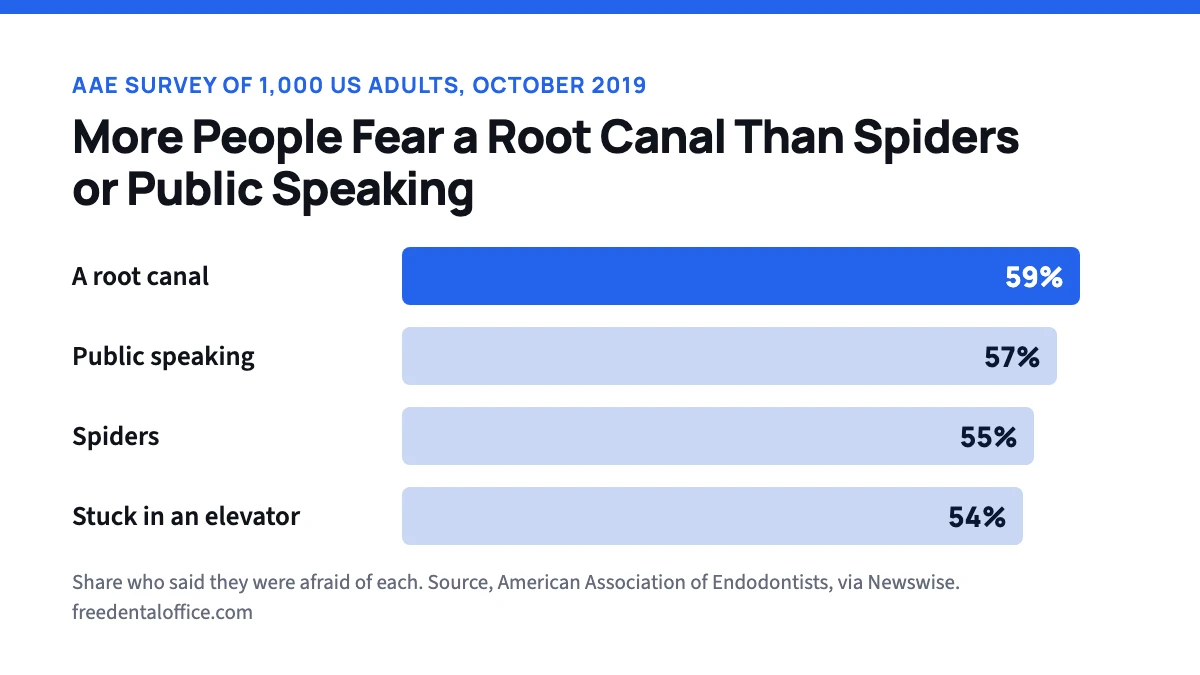
The root canal is the most feared dental procedure. In an October 2019 survey of 1,000 US adults by the American Association of Endodontists, 59 percent said they were afraid of getting one. That beat public speaking, spiders and being stuck in an elevator. The fear is mostly about the pain that comes before the root canal, not the treatment. In California, Medi-Cal Dental covers root canals for adults, and sedation when it is medically necessary.
- Most feared. The root canal, picked by 59 percent in the 2019 AAE survey
- Who fears it more. Women, 65 percent, against 53 percent of men
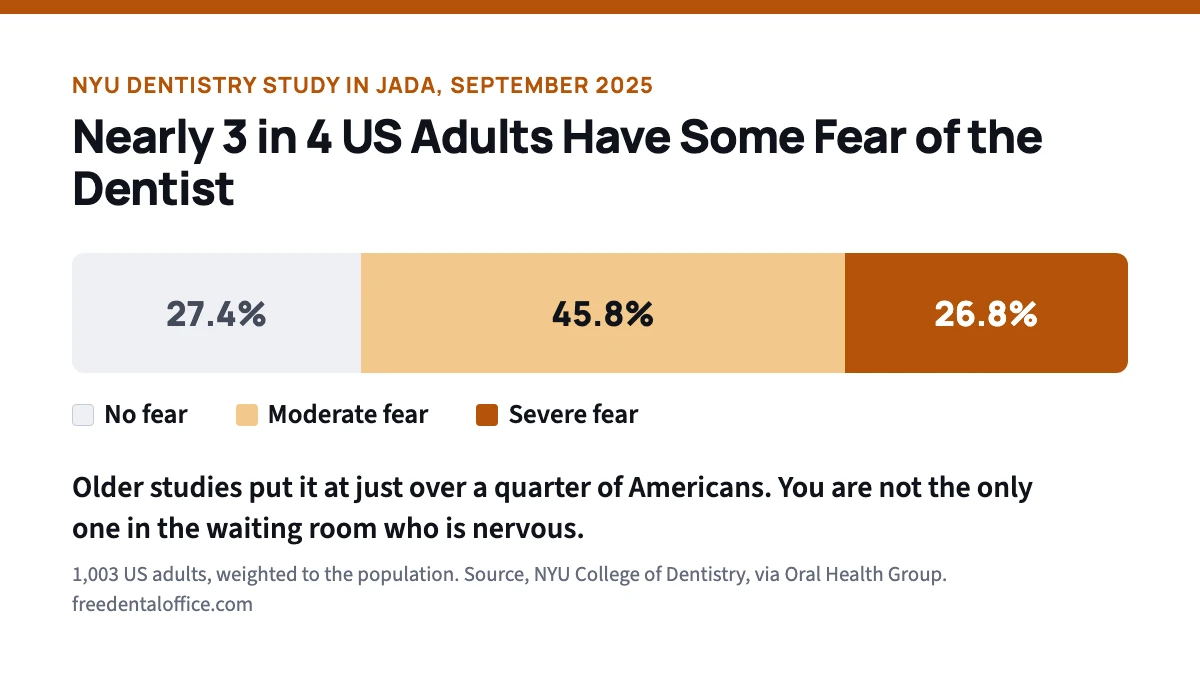
- How common dental fear is. Nearly 3 in 4 US adults have some, per a 2025 NYU study
- What really hurts. The infected tooth before treatment, far more than the visit
- Medi-Cal adults. Root canals, crowns and tooth removal are covered
- Mark the date. Some adults lose full dental on July 1, 2027. Emergency care stays
The Root Canal Tops the List
Ask people which dental work scares them most and one answer keeps winning. The root canal. The American Association of Endodontists, the group for root canal specialists, asked 1,000 US adults in October 2019. 59 percent said they were afraid of getting a root canal.
That put it ahead of public speaking at 57 percent, spiders at 55 percent and being trapped in an elevator at 54 percent. Women were more afraid than men, 65 percent against 53 percent. Younger adults were the most dramatic about it. Among people aged 18 to 24, 73 percent said they would rather speak in public than get a root canal.
Keep in mind who ran the survey. The AAE wants people to keep their teeth, and it has a stake in root canals looking less scary. But the fear numbers are what people said about themselves, and they line up with what dentists hear in the chair every day.
Why the Fear Is Bigger Than the Pain
People get this backward. A root canal does not cause the worst pain. The tooth does. By the time a dentist says root canal, the nerve inside the tooth is usually inflamed or infected, and that is what kept you up at night. The treatment removes the sick nerve, cleans the inside of the tooth and seals it. Once the nerve is out, that pain goes with it.
The people who have actually had one tend to agree. In 2011 the AAE reported that patients who had a root canal were six times more likely to call it painless than people who had never had one. The same report said 89 percent of patients treated by an endodontist were satisfied, and that more than 15 million root canals are done in the US each year.
So where do the horror stories come from? Mostly from older dentistry and from people who waited until the infection had spread. Going in sooner means a smaller problem, and that is one more reason not to wait until your face is swollen.
Fear Versus What Usually Happens
- The needle
- A numbing gel often goes on first, then the shot. Ask for it
- The pain during
- The tooth is numbed first. Say so if you feel pain, and you can stop any time
- The pain after
- Some soreness can follow. Swelling or a fever is a reason to call the office
- The cost
- Covered by Medi-Cal Dental for adults and children
- Too scared to sit
- Sedation is covered when a dentist shows it is medically necessary
- Already in pain
- Where to go tonight with no money
The Other Procedures on the Fear List
The root canal is the headline, but it is not the only thing people dread. Pulling teeth, wisdom teeth most of all, the needle for the numbing shot and the sound of the drill all come up again and again on dental office pages and patient forums.
It helps to split fear from pain. Fear is about the visit. Pain is often about the days after. A root canal usually ends the pain. A pulled tooth leaves a wound that has to heal, so the soreness can come later. Neither one should hurt during the work if the area is numb, and you are allowed to say so if it is not.
If you are choosing between a root canal and pulling the tooth, ask the dentist both questions out loud. Can this tooth be saved, and what happens to my bite if it comes out. A saved tooth keeps its place in your mouth. A gap can let other teeth drift.
Dental Fear Is More Common Than People Admit
If the waiting room makes your heart race, you are in the majority. A study from NYU College of Dentistry, published in the Journal of the American Dental Association in September 2025, surveyed 1,003 US adults weighted to match the country. 72.6 percent reported some dental fear. 45.8 percent had moderate fear and 26.8 percent had severe fear.
That is a lot higher than the old number. The researchers said studies from decades ago put dental anxiety at just over a quarter of Americans. They also pointed to earlier work finding that more than half of people with severe dental anxiety trace it to a painful or upsetting visit as a child or a teen.
There is good news in the same study. 71.2 percent of people with moderate or severe fear said they would try a free, short treatment at home. NYU is testing an app based program called Dental FearLess, and in a small first trial half of the people who finished it said they were no longer fearful.
The Real Danger Is Waiting
Fear does its damage quietly. People who are scared skip the cleaning, skip the check up and only call when a tooth hurts. By then a small cavity that needed a filling can need a root canal, and a tooth that needed a root canal can need to come out. Every step up that ladder is bigger work, a longer visit and more of the thing you were afraid of.
Decay usually starts without pain, in the back teeth and in the gaps between teeth. Our guide on which teeth rot first explains what to look for. A white spot caught early can still heal. A tooth that throbs when you lie down usually cannot wait.
What Medi-Cal Dental Covers When You Are Scared
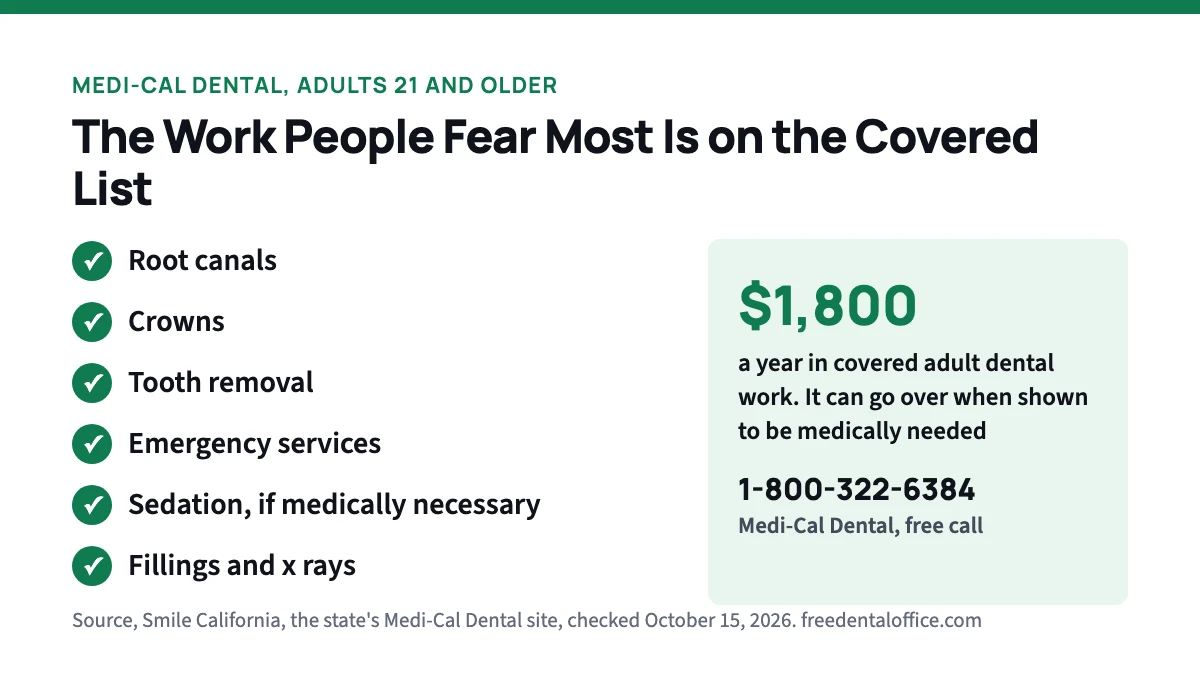
If you are in California and have Medi-Cal, the work people fear most is on the covered list. Smile California, the state's Medi-Cal Dental site, lists root canals, crowns, tooth removal, emergency services and sedation if medically necessary among the services for adults 21 and older. Fillings, x rays, cleanings and dentures are on the same list.
There is a yearly limit. Smile California says Medi-Cal will pay up to 1,800 dollars a year for covered adult dental services, that services can go over that limit if they are shown to be medically needed, and that people who are pregnant may have no yearly limit. Children have their own list, and sedation if medically necessary is on it starting with babies.
Sedation is the line to know if fear keeps you out of the chair. It is covered when it is medically necessary, which means the dentist has to show the need. That is the office's paperwork, not yours. Tell them early that fear is the problem so they can plan for it.
A Date to Know If This Applies to You
Smile California says that starting July 1, 2027, some adult members will lose full dental benefits based on immigration status. If the change applies to you, you can keep using your dental benefits until June 30, 2027.
Emergency dental care stays covered after that date. The site lists examples like a toothache or jaw pain, painful swelling in or around the mouth, an infection with pain or swelling, and a broken or knocked out tooth. Many members keep full dental, including children under 19, people who are pregnant and for one year after, and members with federal full scope Medi-Cal.
If a dentist has already told you that you need a root canal or a crown, and you think the change may apply to you, do not let fear push that visit past June 2027. Call Medi-Cal Dental at 1-800-322-6384 to ask where you stand. The call is free.
How to Get Through the Visit
Say it first. Tell the front desk when you book, and tell the dentist before anything starts. A dentist who knows you are scared will slow down and explain each step.
Agree on a stop signal. Raising a hand is the usual one. Knowing you can stop the work at any moment takes away a lot of the panic.
Ask for the numbing to be checked before they start. Ask whether a numbing gel goes on before the shot. The American Dental Association's patient site, MouthHealthy, says a topical numbing medicine is often put on before the injected one.
Ask about sedation. MouthHealthy describes sedation that can be breathed in, taken as a pill or injected, and general anesthesia, which puts you to sleep, for some cases. Which one fits depends on the work, your health and how anxious you are. On Medi-Cal, ask the office whether they offer it and whether your case qualifies.
Bring someone, wear headphones if the office allows it, and book a time of day when you will not sit and stew for hours. Small things count when you are scared.
Before You Spend a Dime
What is the most feared dental procedure?
The root canal. In an October 2019 survey of 1,000 US adults by the American Association of Endodontists, 59 percent said they were afraid of getting one, more than feared public speaking or spiders.
Is a root canal really that painful?
Usually not during the treatment, because the tooth is numbed. The worst pain tends to come from the infected tooth before treatment. The AAE reported in 2011 that people who had a root canal were six times more likely to call it painless than people who had not.
Does Medi-Cal cover root canals for adults?
Yes. Smile California lists root canals and crowns among the covered dental services for adults 21 and older. Some work needs approval first, which the dental office asks for.
Does Medi-Cal cover sedation at the dentist?
Yes, when it is medically necessary. Smile California lists sedation if medically necessary for adults and for children. The dentist has to show the need, so tell the office early that fear is the problem.
How many people are afraid of the dentist?
Nearly 3 in 4 US adults have some fear, according to a 2025 NYU College of Dentistry study of 1,003 adults. About 27 percent had severe fear.
Will Medi-Cal still cover a toothache after July 2027?
Yes. Smile California says emergency dental services stay covered for Medi-Cal members, including a toothache, painful swelling and infection. Some adults lose full dental benefits on July 1, 2027 based on immigration status.
Sourced From
- American Association of Endodontists via Newswise, survey of 1,000 US adults (October 22, 2019)
- News-Medical, AAE wants to dispel negative myths about root canal treatment (March 25, 2011)
- Oral Health Group, NYU College of Dentistry study on dental fear in JADA (September 2025)
- Smile California, Covered Services for Adults (21 to 54)
- Smile California, 2027 Medi-Cal Dental Benefit Changes
- American Dental Association, MouthHealthy, Anesthesia and Sedation
Next Problem to Solve
- What Denti-Cal Pays For. A Plain ListWhat Medi-Cal dental covers for adults and children, what it does not, and how to check before you agree to treatment.
- Which Teeth Usually Rot First? The Answer Changes With AgeThe back molars rot first for most people. Babies, children and older adults each have their own weak spot. What early decay looks like and when it can still heal.
- Your Tooth Hurts and You Have No Money. What NowWhere to go when a tooth is hurting and you cannot pay, including what an emergency room can and cannot do for a dental problem.